
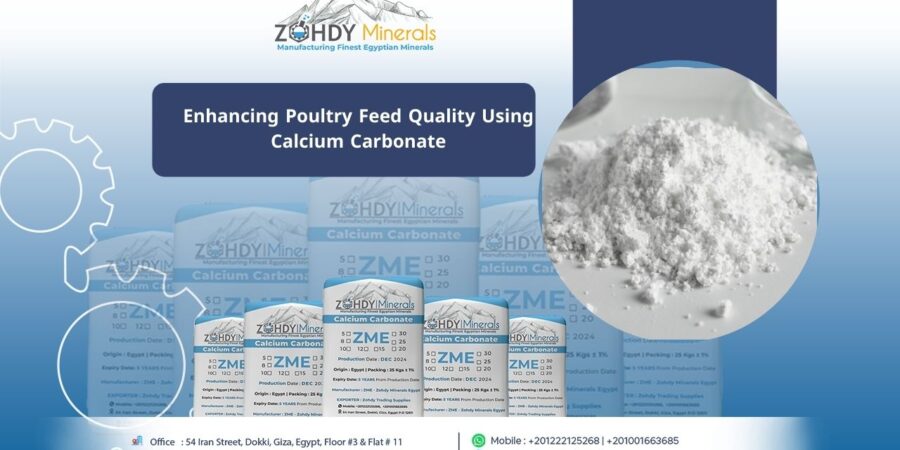
Enhancing Poultry Feed Quality Using Calcium Carbonate is a fundamental step to ensure bird health and improve their productivity. Calcium is a vital element for bone formation, enhancing egg production, and maintaining digestive system balance in poultry.
Calcium carbonate works to raise the calcium value in the feed, helping farmers maximize the benefit of their feed and improve production quality. For this reason, many poultry farmers rely on calcium carbonate in the daily nutritional mixtures for their birds.
In this context, Zohdy Minerals Egypt supplies the best types of high-quality calcium carbonate perfectly suited for manufacturing poultry feed, ensuring the needs of the agricultural and industrial market in the Kingdom are met with the highest efficiency and safety.
Using calcium carbonate from reliable sources like Zohdy Minerals Egypt is a smart investment for every poultry farmer seeking to naturally and effectively enhance production quality and boost bird health.
Enhancing Poultry Feed Quality Using Calcium Carbonate
A recent study revealed that human consumption of poultry has increased to 70% of global consumption, while the demand for other previously popular meats has declined.
Therefore, poultry deserves full attention to the quality of its diet, ensuring it includes diverse nutrients, most importantly Calcium.
Calcium plays a significant role among the indispensable nutrients in the formation of the skeletal structure of birds and the formation of the outer shell of poultry eggs, where calcium carbonate constitutes about 79% of this shell.
Just as calcium plays a major role in the bone formation phase of young poultry, the need for it increases when chickens reach laying age.
The most important and cheapest source of calcium is Calcium Carbonate, which contains 35-40% calcium (lime – tile powder) and is added at a rate of 10-20 kg per ton of feed.
Types of Calcium Carbonate Used in Poultry Feed Formulation
The calcium carbonate used in poultry feed must contain 36-38% calcium and comes in two forms:
-
Fine-Ground Limestone Powder (Tile Powder): This is consistently considered the most economical source of calcium in poultry nutrition and is the base source relied upon for calcium in animal and bird rations.
The condition is to completely avoid any colored tile powder, as these added colors may be toxic to the animal.
Therefore, raw tile powder of a bright white color or one that slightly leans towards yellow should be used.-
Tile powder is always used as a free-choice source for breeding and laying birds if not all calcium has been added to the feed.
-
The addition rate of tile powder (calcium carbonate) to poultry feed varies depending on the type of feed ingredients used in the rations. For example, hay, clover, and alfalfa contain high amounts of calcium, so if the feed relies heavily on these types, the amount of added calcium carbonate must be reduced.
-
-
Coarsely-Ground Limestone: This is also used in all mash rations for laying hens to reduce dusty problems due to its high alkalinity and its ability to kill most bacteria and viruses, especially bird flu and coccidia, which are carried on car tires, feet, and in the air.
-
Poultry farmers are well aware that various poultry diseases occur at a very high rate due to the litter, which acts as an intermediate host between the poultry and the disease.
Therefore, adding coarse lime to the litter periodically is necessary to protect the poultry from these diseases.
-
A Safe Method for Using Coarse Lime to Sanitize Poultry Farms
Coarse lime (Quicklime, not CaCO3) is primarily used for disinfecting farms and barns, but it is rarely added to rations except in special cases and limited quantities to avoid its strong alkaline effect on poultry digestion.
Typically, lime is sprayed on the ground after the farm is emptied of animals, and then water is sprayed over it, leading to the emission of vapors and heat that help sterilize the floor.
Poultry are not reintroduced to the area until the vapor emission has stopped for two days to ensure the quicklime has converted into safe slaked lime, The ground is then covered with soil or sand before the animals are brought back in.
Calcium Carbonate Grains (Grit) as Poultry Feed
The recommended size of calcium carbonate stones or grit varies according to the age and size of the chicken. Here are some examples:
-
Adult Laying Hens: Calcium carbonate stones sized approximately 1 to 4 mm are recommended. This is large enough to be picked up into the adult chicken’s crop to help grind the feed.
-
Growing Chicks: The calcium carbonate stones used for young chicks should be smaller than those used for adult chickens, approximately 1 to 2.5 mm.
It is important to note that calcium carbonate stones should not completely replace powdered calcium carbonate in chicken feed, as they do not contain the necessary amount of calcium relative to their size. Calcium carbonate stones must be used with a balanced diet that contains the appropriate amount of powdered calcium carbonate to meet the chicken’s nutritional needs.
Boosting Poultry Productivity and Feed Quality with Calcium Carbonate
Focusing on the quality of poultry feed and using natural materials rich in essential nutrients like calcium carbonate is the cornerstone of any successful poultry farming project.
Calcium’s role is not limited to building strong bones in birds; it also extends to improving egg production, supporting the overall health of the digestive system, and contributing to the prevention of many common poultry diseases.
Farmers’ reliance on calcium carbonate in its various forms—whether fine powder, small granules, or grit—helps meet the nutritional needs of birds at their different growth stages, while considering the differences between young and adult chickens.
It also plays a role in enhancing digestive efficiency and stabilizing the minerals necessary for producing high-quality eggs.
Enhancing Poultry Feed Quality Using Calcium Carbonate
Furthermore, using coarse limestone for farm disinfection is an important step in maintaining a healthy environment free from bacteria and viruses, which directly reflects on bird growth rates and reduces disease incidence.
These practices make calcium carbonate a smart investment for farmers seeking high productivity and excellent nutritional quality naturally and safely,
without relying on harmful chemicals or industrial additives that could negatively affect the health of birds and consumers.
In summary, calcium carbonate is not just a food ingredient; it is a strategic element that ensures the sustainability of agricultural and animal production and enhances the quality of final products, benefiting both farmers and consumers.
With the availability of reliable and high-quality sources of calcium carbonate from Zohdy Minerals Egypt, achieving an optimal balance between poultry health and production efficiency becomes possible,
enabling every poultry farmer to achieve the best results naturally and safely while sustainably raising productivity and profitability. Contact Us.