
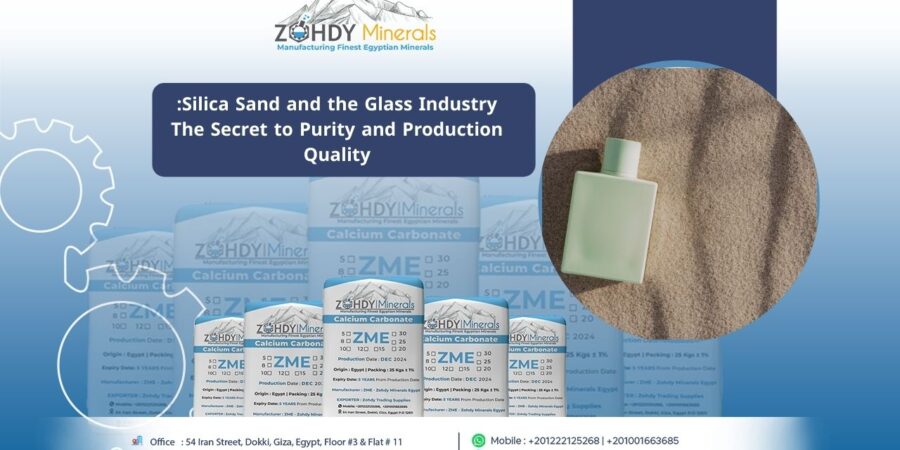
The glass industry is one of the oldest industries known to humanity, and despite its development over the ages, Silica Sand remains the essential component in this sector.
The chemical and physical properties of silica sand determine the quality of the final glass and play a major role in defining its strength, transparency, and color.
The Importance of Silica Sand in the Glass Industry
Silica sand is characterized by a high concentration of Silicon Dioxide (SiO2), which is the most influential element in glass production. The higher the concentration of silica in the raw material, the fewer the impurities, and consequently, the glass becomes purer and harder.
The percentage of Iron Oxide (Fe2O3) also affects the color of the glass. Pure white sand is nearly free of iron, yielding transparent and flawless glass, whereas red sand contains a high percentage of impurities, resulting in lower quality glass.
In addition to the chemical composition, the particle size distribution of silica sand plays a vital role in the industry. Very small grains may contain impurities and can volatilize during melting, causing foaming in the tanks, while very large grains affect the glass’s hardness and purity.
Therefore, grain sizes should range between 125 microns and 1000 microns to achieve the best results.
Essential Materials for Glass Production and Their Quality
The glass industry uses fine raw materials to achieve the required properties, the most important of which are:
-
Silica: To provide the necessary silicon oxide for forming the glass structure.
-
Sodium Carbonate (Na2CO3): To lower the melting temperature, which facilitates the glass manufacturing process.
-
Calcium Oxide (CaO): To increase the glass hardness and improve its resistance to breakage.
-
Lead Oxide (PbO): To improve the glass luster and purity in certain specialized types, such as crystal glass.
These combined components ensure the production of high-quality glass suitable for various uses such as household utensils, windows, and colored glass.
Silica Sand in Saudi Arabia
Saudi Arabia possesses a vast wealth of high-purity silica sand, especially in several regions where glass sands are prevalent.
The silica percentage in these raw materials typically ranges between 95% and 97%, while impurities such as Aluminum Oxide (Al2O3) and Iron Oxide (Fe2O3) are within the required limits for glass manufacturing.
Therefore, some types of sand require additional purification processes to raise the silica percentage and reduce impurities.
This is what leading companies like Zohdy Minerals Egypt provide in Saudi Arabia to ensure the materials comply with global standards for the glass industry.
The Impact of Color and Purity on Glass Quality
The color of the sand is one of the primary factors determining the quality of the final glass:
-
White Sand: The highest purity, used to produce transparent, flawless glass.
-
Yellow Sand: Contains a low percentage of impurities, used in semi-transparent glass.
-
Red Sand: Rich in impurities, and its use is limited in high-quality glass.
The lower the percentage of iron oxide, the greater the glass’s transparency and beauty, which makes selecting the appropriate sand crucial in the industry.
Particle Size Distribution: The Key to Hardness and Purity
The process of sorting and classifying grains by size is extremely important. Ultra-fine grains may contain impurities and cause problems during melting, while very large grains affect smoothness and transparency.
Maintaining the grain size gradation between 125 microns and 1000 microns ensures the production of defect-free glass with high hardness.
Using Silica Sand in Different Glass Types
Glass manufacturing is not just about combining materials; it depends on the chemical composition of the silica sand to determine the type of glass to be manufactured:
-
Transparent Glass: Relies on pure white sand with a high silica percentage.
-
Colored Glass: Requires controlling the percentage of iron oxide and other impurities.
-
Industrial Glass: Such as heat-resistant glass and insulated glass, requires a precise particle size distribution and additional materials like calcium oxide and sodium oxide.
Selecting the Right Sand is the Key to Success
It can be stated that the quality of the final glass depends directly on the properties of the silica sand in terms of chemical composition, silica percentage, impurity content, and grain size.
Specialized mining companies like Zohdy Minerals Egypt in Saudi Arabia play a pivotal role in providing these high-quality materials to meet the needs of the local and global glass industry.
By using pure and appropriate silica sand, the Saudi glass industry can produce high-quality products that are shatter-resistant, perfectly transparent, and colored, thereby enhancing its position in international markets. Contact Us.