
Soil salinity is one of the most significant challenges facing agriculture worldwide, particularly in arid and semi-arid regions. Saline soil negatively impacts plant growth and reduces fertility, leading to a decline in agricultural productivity.
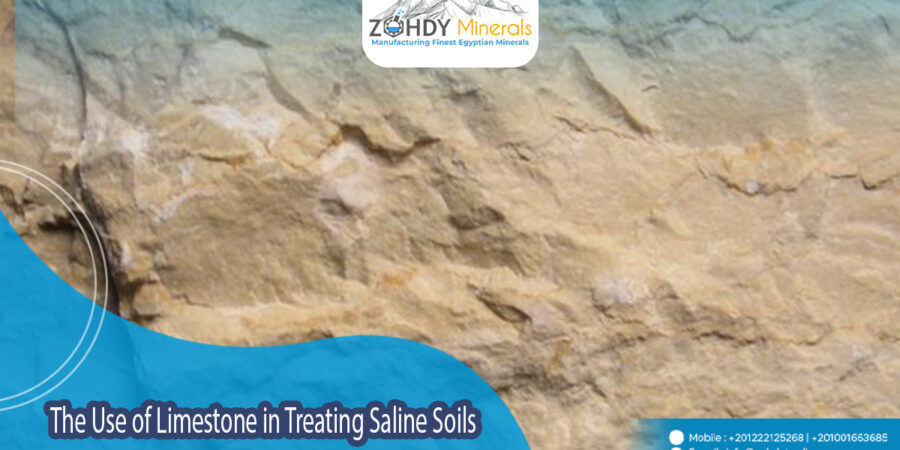
Limestone in Treating Saline Soils, rich in Calcium Carbonate (CaCO3), serves as a natural agent that can adjust soil pH, improve soil structure, and enhance nutrient absorption essential for plants.
In this article, we explain the methods of using Limestone in Treating Saline Soils, its chemical mechanisms, and the best practices for application.
Zohdy Minerals Egypt offers premium limestone at competitive prices with rapid export services, making it the ideal choice for Saudi companies seeking a reliable supplier. Contact Us.
Understanding Saline Soil and Its Causes
Saline soil contains high concentrations of water-soluble salts, such as Sodium Chloride (NaCl), Sodium Sulfate (Na2SO4), and Calcium Chloride (CaCl2). High salinity levels disrupt the nutrient balance and hinder water uptake by plant roots.
Primary Causes of Salinity:
-
Natural Sources: Chemical weathering of mineral-rich rocks and high groundwater levels that bring salts to the surface.
-
Human Activity: Irrigation with saline or brackish water, excessive use of chemical fertilizers, and poor agricultural drainage.
Impact of Salinity on Soil and Plants
-
Stunted Growth: High salt concentrations reduce the osmotic potential, making it harder for plants to absorb water, leading to wilting.
-
Soil Degradation: Dissolved salts lead to sodium accumulation, which destroys soil structure, causing it to become hard and compacted.
-
Biological Impact: High salinity reduces the activity of beneficial soil microbes, hindering the decomposition of organic matter.
Limestone: Properties and Role in Agriculture
Limestone is a sedimentary rock composed primarily of Calcium Carbonate (CaCO3).
It is a natural and effective tool for soil remediation.
-
Chemical Function: High CaCO3 content allows it to neutralize soil acidity and raise pH levels.
-
Physical Function: It can be ground into a fine powder for easy distribution across agricultural lands.
-
Soil Amendment: Limestone improves soil aeration, moisture retention, and reduces the “ionic stress” caused by excessive sodium.
Chemical Mechanism: How Limestone Treats Saline Soil
When Limestone in Treating Saline Soils, a critical chemical reaction occurs:
-
Sodium-Calcium Exchange: Calcium ions (Ca2) from the limestone displace sodium ions (Na^+) attached to soil particles.
The liberated sodium can then be leached away by irrigation or rainfall, reducing the soil’s sodicity. -
pH Neutralization: In acidic soils, the carbonate works to raise the pH to a level more suitable for nutrient availability.
-
Flocculation: Calcium promotes the aggregation of soil particles (flocculation), which improves drainage and prevents soil crusting.
Types of Limestone for Soil Treatment
-
Pulverized Limestone: The most common form, ground into a fine powder for rapid reaction.
-
Granular Limestone: Used for specific applications where a slower, long-term release of calcium is required.
-
Ultra-Fine Ground Limestone: Ensures an immediate effect in highly acidic or severely saline lands.
Application Methods
-
Soil Analysis: Conduct a comprehensive soil test to determine salinity (EC) and sodium (SAR) levels to calculate the exact dosage.
-
Dosage Determination: Typically ranges from 2 to 5 tons per hectare, depending on soil texture (sandy vs. clay) and crop type.
-
Distribution:
-
Surface Application: Spreading pulverized limestone followed by plowing to mix it thoroughly.
-
Organic Mixing: Combining limestone with organic compost to enhance both chemical and physical soil properties.
-
Post-Application Irrigation: Essential to dissolve the limestone and facilitate the leaching of displaced sodium ions.
-
Benefits of Using Limestone in Treating Saline Soils
-
Salinity Reduction: Displaces harmful sodium with beneficial calcium.
-
Improved Structure: Enhances aeration and root penetration.
-
Increased Fertility: Boosts crop yields by improving nutrient uptake.
-
Sustainability: A natural, eco-friendly material that reduces reliance on harsh chemicals.
Proven Results
Studies in various Arab regions have shown that limestone application can:
-
Reduce soil sodium levels by up to 40% after one growing season.
-
Increase productivity of crops like wheat and barley by 20–30%.
-
In Egypt, trials showed that mixing pulverized limestone with organic manure yielded significantly faster results in salinity reduction compared to using limestone alone.
Limestone is a powerful and sustainable tool for reclaiming saline lands. By improving soil architecture and reducing salt stress, it ensures long-term agricultural sustainability and food security.
Zohdy Minerals Egypt is committed to the highest quality standards in limestone production, ensuring our products meet the rigorous requirements of the Saudi agricultural market.
For premium quality and the best export prices in Saudi Arabia, contact us today.