
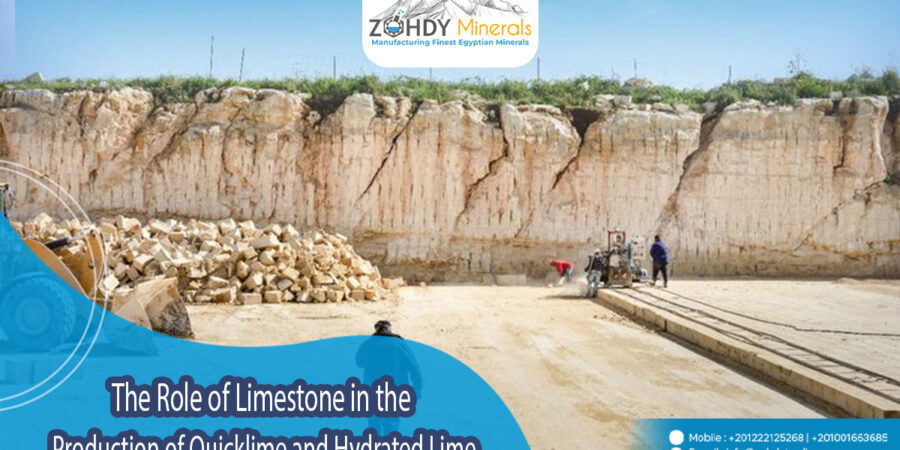
Limestone in the Production of Quicklime and Hydrated Lime, Limestone is one of the most critical natural materials that has played a pivotal role in the evolution of chemical industries and construction materials throughout history.
This importance stems from its high content of Calcium Carbonate (CaCO3), which serves as the primary raw material for producing quicklime and hydrated lime.
These two products are essential components in numerous industrial applications, including construction, water treatment, and metallurgical industries.
Zohdy Minerals Egypt is a prominent leader in the mining sector, relying on high-quality limestone for its industrial operations. Limestone in the Production of Quicklime and Hydrated Lime. Contact Us.
With extensive experience in extraction and processing according to the highest standards, the company supplies various factories with limestone and lime products.
This support strengthens local industries, enhances the quality of construction materials, and contributes to the development of the mining sector through modern technologies that ensure production efficiency and resource sustainability. Limestone Composition and Primary Characteristics
Limestone consists mainly of Calcium Carbonate (CaCO_3) and may contain various impurities such as clay, silica, iron oxides, and magnesium. The quality of limestone used in lime production is determined by its chemical purity; the higher the CaCO_3 percentage, the higher the quality of the resulting lime.
Key characteristics of limestone include:
-
Moderate Hardness: Easily crushed and ground for processing.
-
Abundant Availability: Making it an economical raw material for various industries.
-
Thermal Stability: Allows it to withstand high-temperature calcination processes.
Limestone in the Production of Quicklime and Hydrated Lime
Quicklime, also known as burnt lime or unslaked lime, is Calcium Oxide (CaO). It is obtained by calcining limestone in specialized kilns at high temperatures ranging from 900°C to 1100°C.
This thermal process is essential for converting the Calcium Carbonate in limestone into pure Calcium Oxide, a fundamental substance in construction, chemical manufacturing, and environmental treatment.
The Calcination Process:
-
Decarbonization: Heating CaCO3 releases Carbon Dioxide (CO2) gas.
-
Mass Reduction: Limestone loses nearly half its weight due to the release of CO2.
-
Chemical Transformation: The structure changes completely into a highly reactive material.
-
Kiln Technology: Rotary or vertical kilns are used, powered by gas, coal, or biofuels.
Key Applications of Quicklime:
-
Iron and Steel Industry: To remove impurities from molten metals.
-
Water Treatment: Adjusting pH levels and removing turbidity.
-
Chemical Industry: Acting as a catalyst in numerous reactions.
-
Paper Industry: Used in pulp bleaching processes.
Hydrated Lime Production: Calcium Hydroxide
Hydrated lime, or slaked lime, is Calcium Hydroxide Ca(OH)2, It is a fine white powder produced by reacting quicklime with water in a process called “slaking.”
The Slaking Process involves:
-
Exothermic Reaction: Significant heat release that can cause water to boil.
-
Volume Expansion: The volume of the material increases as it absorbs water.
-
Physical Change: Transformation from hard lumps into a fine, manageable powder.
Key Applications of Hydrated Lime:
-
Construction: Used in mortars and lime-based coatings.
-
Water & Wastewater Treatment: Raising pH levels and removing heavy metals.
-
Agriculture: Improving soil properties and neutralizing acidity.
-
Environmental Protection: Absorbing Sulfur Dioxide (SO_2) emissions in industrial plants.
The Integrated Industrial Chain
The entire cycle begins with limestone as the primary raw material and transforms through two stages:
-
Stage One (Calcination): Limestone \rightarrow Quicklime (CaO).
-
Stage Two (Slaking): Quicklime + Water \rightarrow Hydrated Lime (Ca(OH)2).
Importance of Quality Control
The efficiency of the final lime product depends on the purity of the limestone (high CaCO_3 percentage), the type of impurities present, and the precision of the burning temperature.
Pure limestone, free from magnesium impurities, is vital for high-precision applications in the chemical and pharmaceutical industries.
Industrial and Environmental Significance
-
Industrial Development: Lime is essential for infrastructure, from cement and glass to metal separation in mining.
-
Environmental Sustainability: It improves wastewater quality, reduces harmful industrial emissions, and enhances agricultural soil fertility.
Limestone in the Production of Quicklime and Hydrated Lime industries. From construction and chemicals to water treatment and soil enhancement, these materials form an integrated chain of industrial and environmental applications.
Zohdy Minerals Egypt remains at the forefront of this sector, providing limestone and lime products processed to the highest global standards, thereby supporting industrial growth and environmental sustainability in the region. Contact Us.