

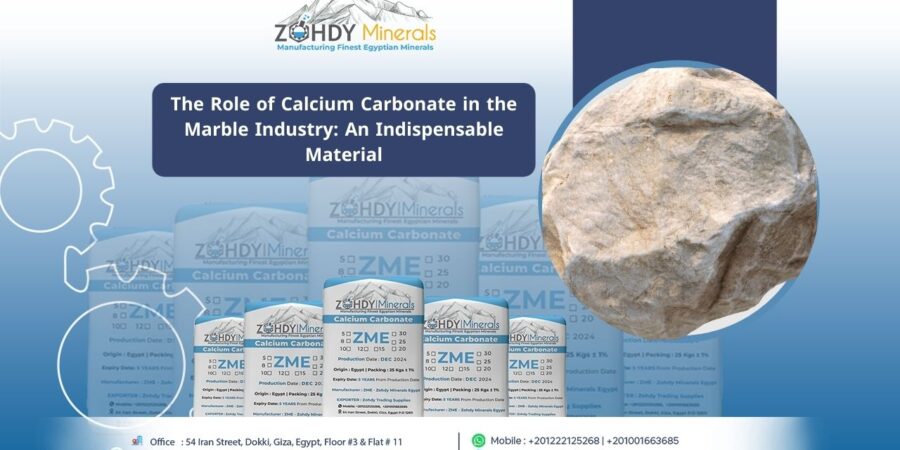
Calcium Carbonate in the Marble Industry is one of the most widespread and utilized materials in the industrial world, capturing nearly 70% of the global market share thanks to its numerous vital applications across various sectors.
This naturally abundant material has become an essential component in many industries relied upon daily by humanity.
This material is not merely an industrial component; it forms the fundamental factor for producing many types of natural and engineered marble, offering strength, durability, and unique aesthetic touches that make it the primary choice in construction and interior design projects.
The role of calcium carbonate is not limited to marble production; its importance extends to other building materials such as cement, concrete, and paints, where it acts as a main component affecting the final product’s quality and efficiency.
Thanks to its superior physical and chemical properties, this material has become an integral part of modern building materials development, contributing to the enhanced efficiency of construction projects worldwide.
Calcium Carbonate in the Marble Industry and Its Luxurious Quality
Due to its anti-acid properties, calcium carbonate is used in industrial environments to neutralize acidic conditions in both soil and water.
The reaction between acid and calcium carbonate occurs on the marble surface, where calcium carbonate decomposes to form carbon dioxide and lime.
The larger the surface area, the faster the reaction.
Calcium carbonate contributes to making the mortar used to bind bricks, concrete blocks, stones, roofing slabs, rubber compounds, and tiles.
Since calcium carbonate constitutes coarse, metamorphic crystalline rocks that are more compressed than chalk, it forms when chalk or limestone recrystallizes under conditions of high temperature and pressure to transform into marble.
Chemical Composition of Calcium Carbonate
Calcium carbonate has the chemical formula CaCO3 and is a common substance found in rocks as the minerals calcite and aragonite.
The most prominent form of calcium carbonate is limestone, a type of sedimentary rock primarily composed of calcite.
Calcium carbonate is also the main component of eggshells, snail shells, seashells, and pearls.
The pure powdered calcium carbonate (CaCO3) is white, very fine, and processed from natural calcium carbonate with the following approximate chemical composition:
-
CaCO3: 97.2%
-
Al2O3: 0.04%
-
SiO2: 0.12%
-
MgCO3: 2.12%
-
Fe2O3: 0.03%
Calcium Carbonate in the Marble Industry
Marble is known as one of the purest metamorphic sedimentary rocks in terms of chemical composition. Most geological studies and tests show that the percentage of CaCO3 in it usually exceeds 93%, sometimes reaching 96% or more in high-quality samples.
This high concentration of CaCO3 is what gives marble its stark whiteness, hardness, and homogeneous texture.
Other elements like Magnesium Oxide (MgO) and Iron Oxide (Fe2O3$) appear in very small amounts, limiting their impact on the marble’s properties.
The higher the percentage of calcium carbonate, the higher the stone’s quality, aesthetic, and structural value, which explains the high demand for pure marble types in decoration and architecture.
Advantages of Using Engineered (Artificial) Marble
Engineered marble is a practical and modern choice that combines the aesthetic appeal of natural marble with enhanced properties sought by users in homes and projects.
This type of marble is manufactured using composite materials that give it high strength and a smooth, streamlined texture, making it suitable for various uses such as flooring, entrances, stairs, and kitchen countertops.
Engineered marble is available in a wide range of colors and patterns, allowing for easier coordination with different interior designs.
It is also characterized by being more resistant to scratches and stains compared to natural marble, and its cost is typically lower, making it an economical option without compromising a luxurious appearance.
Other advantages of using engineered marble include:
-
Aesthetic Beauty: Achieved through the use of pigments and colors that may not be available in natural marble, lending it perfect aesthetics.
-
Attractive Luster: Due to the use of resin to fill the pores between the crushed marble particles.
-
Easy Maintenance: Simple to maintain when exposed to minor scratches.
-
Non-Porous: A protective layer is applied to it, unlike natural marble, which is porous and absorbs liquid colors if spilled.
-
Easy Cleaning: Simple to clean using a soft sponge.
-
Lower Cost: Generally less expensive than natural marble.
-
Easy Installation: Can be installed easily without the need for small additional pieces, as it is designed and manufactured based on precise measurements.
Uses of Engineered Marble
Engineered marble is used:
-
As an alternative to ceramics, natural marble, or porcelain in floor finishes.
-
In stair finishes.
-
In paving tiles for sidewalks.
-
In interior wall finishes to add a distinctive aesthetic touch at a lower cost than natural marble.
-
In kitchen and bathroom countertops due to its high resistance to moisture and easy cleaning.
-
In the manufacturing of sinks and vanity tops inside bathrooms and kitchens.
-
In modern decorations such as tables and reception desks in offices and hotels.
-
For covering columns and architectural decorations, as it is easy to shape and provides a luxurious look.
The Indispensable Element
In conclusion, calcium carbonate plays a vital and indispensable role in the marble industry.
It grants both natural and engineered stone the strength, durability, and aesthetic touch that makes each piece unique and distinguished.
Furthermore, the use of this material reflects the commitment of modern industries to quality, efficiency, and innovation, as it contributes to improving the properties of other building materials like cement, concrete, and paints, thus enhancing the durability of urban projects and adding aesthetic value to internal and external spaces.
Thanks to its expertise and high-quality natural resources, Zohdy Minerals Egypt continues to provide pure and ideal calcium carbonate to meet the needs of the marble industry and various building materials.
This commitment ensures that manufacturers and consumers receive products that are durable, resistant, and beautiful simultaneously, aligning with the highest global standards and achieving a perfect balance between quality, aesthetics, and economy.
Thus, calcium carbonate, through its essential role and effective contribution, remains the cornerstone of the marble industry and an important tributary to the development of the construction and interior design sector in the Kingdom and beyond. Contact Us.