

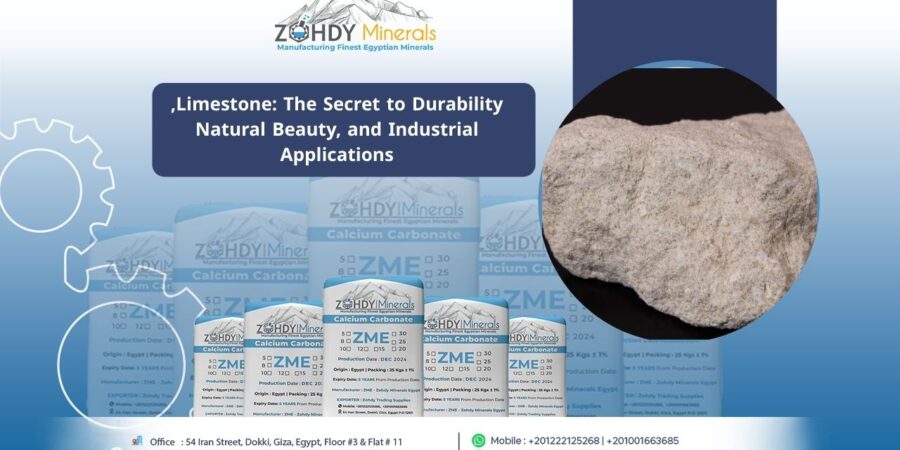
Limestone is considered one of the most important sedimentary rocks on the Earth’s surface due to its great significance in numerous industries such as construction, fertilizers, and chemical production.
This rock is primarily composed of Calcium Carbonate (CaCO3) and may sometimes contain amounts of dolomite. Limestone is characterized by its varying colors, ranging from white, yellow, to gray, and is typically extracted from shallow marine areas.
With the increasing demand for raw materials, Zohdy Minerals Egypt in Saudi Arabia plays a pivotal role in exploiting limestone and meeting local and international industrial needs.
Types of Limestone
Limestone types vary based on their formation methods, constituent elements, and colors. The main varieties include:
-
Chalk
-
Coral Limestone
-
Shell Limestone
-
Travertine
-
Black Limestone
-
Coquina
-
Crystalline Limestone
-
Dolomitic Limestone
-
Fossiliferous Limestone
-
Lithographic Limestone
-
Oolitic Limestone
-
Tufa
Limestone Characteristics
Limestone is distinguished by several characteristic properties, including:
-
It can be split in different directions and carved or cut into a wide range of shapes and sizes.
-
It is highly homogeneous.
-
Its external appearance improves over time, and its colors become more beautiful.
-
Limestone features regular texture.
-
Its appearance naturally changes over time.
-
Limestone is classified into three different categories based on its density: low-density, medium-density, and high-density.
-
It contains a high percentage of calcium.
-
It is characterized by its ability to reduce pollution.
Uses of Limestone
Limestone is used in many fields, such as construction and agriculture, due to its advantages that make it the best choice for these applications:
-
Dimension Stone: Limestone is crushed and cut into blocks and slabs of various dimensions for use in floor tiles, stair treads, and window sills.
-
Roofing Granules: Limestone is converted into fine-grained powder used as a weather and high-temperature resistant coating, and as a top layer for roofs.
-
Flux Agent: Powdered limestone is used in metal refining and smelting processes.
-
Portland Cement: Limestone is used after being heated in a kiln with shale, sand, and other materials. It is then ground into a powder, solidified by mixing it with water, and used in construction.
-
Lime: Used as an agent to treat acidic soil in agriculture and as an auxiliary agent to neutralize acids in chemical industries.
-
Animal Feed: Used as a nutritional supplement for chickens, as calcium carbonate is provided to produce strong eggshells. It is also added to cow feed to compensate for large losses of calcium carbonate due to milking.
-
Mine Dust: Also called “rock dust,” powdered limestone is a white powder sprayed on exposed coal surfaces in underground mines to improve lighting and reduce the amount of suspended coal dust in the mine air, thereby improving breathability and reducing the risk of explosion caused by flammable coal dust particles suspended in the air.
-
Heavy Industries: Limestone is used in steelmaking to remove impurities from iron.
-
Filler in Manufactured Goods: Powdered limestone is used as a filler in paints, detergents, paper, and carpets.
-
Plastics: Limestone is used in the production of plastics and rubber. Being a non-reactive material, it is considered the best for this industry.
-
Neutralizing Agent: Limestone is added to water to remove impurities and pollutants. Because it is primarily composed of basic calcium carbonate, it is used to neutralize acidity in industrial waste and surface runoff water.
-
Construction and Home Decor: Contractors prefer using limestone in construction to provide a durable floor and wall covering similar to granite and marble.
-
Water Treatment: Limestone tanks are used in rural areas due to the ability of limestone to reduce acidity from water and remove iron and its by-products.
Practical and Aesthetic Advantages of Limestone
-
Durability and Strength: Limestone has sufficient hardness to withstand daily use, making it a long-term option for floors and exterior/interior walls.
-
Easy Maintenance: Limestone requires simple maintenance compared to some other materials; it can be easily cleaned using natural products or mild detergents.
-
Variety of Colors and Patterns: Limestone is available in a wide range of natural colors and patterns, giving designers and architects greater freedom for innovation and personalization of spaces.
-
Sound Absorption: Thanks to its porous structure, limestone helps improve the acoustic properties of a space, reducing reflections and ambient noise.
Limestone Formation: A Natural Journey Through Geological Time
Limestone formation is a living testament to the slow but powerful forces of nature over millions of years. This rock primarily forms in clear, warm, shallow marine waters where the remains of marine organisms such as shells, coral, and algae, along with carbonate-rich marine organism waste, accumulate.
Over time, these organic materials are subjected to pressure and lithification, gradually transforming into a cohesive solid rock known as limestone.
Limestone can also form through the direct precipitation of calcium carbonate from lake or ocean waters. It thus plays a dual role: it is not just a natural building material, but also a geological archive that narrates the Earth’s story through time, recording the evolution of marine organisms and environmental changes across geological eras.
The Colors and Hardness of Limestone: The Secret to its Strength and Natural Beauty
Limestone rocks are characterized by the diversity of their physical properties, which makes each type unique. From their smooth texture and fine porosity to their compact hardness, and from their magnificent colors that range between white, gray, and black, to shades of yellow and brown, these qualities form a blend of beauty and strength. These properties are not limited to visual appeal but also determine their utilization in multiple fields, from luxury building materials to crushed stone used in road construction and infrastructure.
The Role of Zohdy Minerals Egypt Company in Limestone Exploitation
Limestone is one of the most important natural resources that combines natural beauty with practical utility.
It is not just a sedimentary rock forming part of the Earth’s topography; it is also an essential material in many vital industries such as construction, fertilizers, chemical industries, iron and steel manufacturing, and even in agriculture and home decoration.
Limestone rocks are characterized by their diverse colors and natural hardness, making them the optimal choice for engineers and designers seeking a balance between durability and beauty, alongside their distinctive environmental properties in reducing pollution, treating water, and improving air quality in industrial areas.
What adds extra value to this natural resource is the vital role played by leading mining companies in exploiting it sustainably and efficiently.
Prominently among these is Zohdy Minerals Egypt in Saudi Arabia, which has succeeded in investing in limestone to meet the needs of the local and foreign markets.
The company ensures the provision of high-quality products that meet the requirements of various industries.
The company has focused on extracting limestone from the best marine and terrestrial sites while maintaining the highest safety and quality standards, making it a reliable partner for factories, contractors, and the agricultural sector alike.
Due to its multiple properties—hardness, durability, natural beauty, and industrial and environmental functions—limestone remains an indispensable material and a key component in economic development and infrastructure.
Zohdy Minerals Egypt contributes to the sustainability of these resources and offers innovative solutions to various industries, thus preserving the natural form of the Earth and blending nature with the modern needs of industry and society.
Limestone is not merely a rock we see under our feet but a witness to the Earth’s history and an effective tool for building a prosperous and sustainable present. Contact Us.