
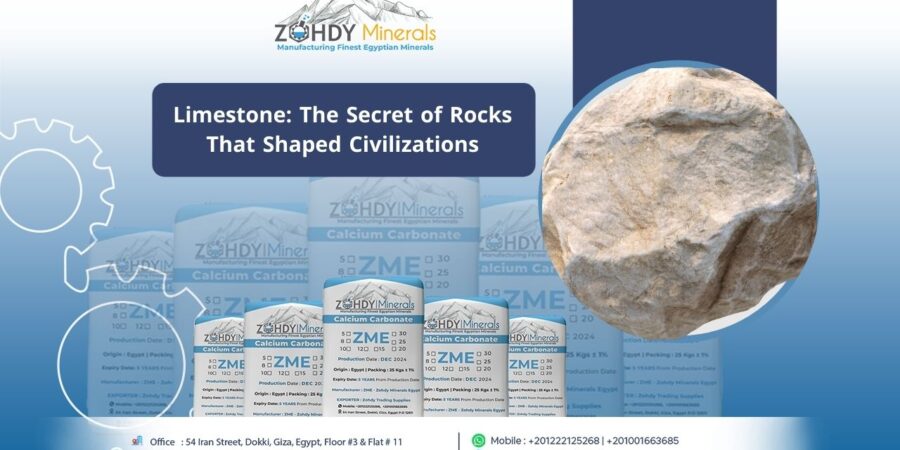
Limestone is one of the most important natural rocks that has played a significant role in shaping geological environments and various industries throughout time.
This rock is primarily composed of fossilized remains of marine organisms (such as mollusks and coral reefs), where these sediments gradually transform into sedimentary rocks rich in Calcium Carbonate (CaCO3) in its various crystalline forms, such as aragonite.
Zohdy Minerals Egypt in Saudi Arabia emerges as a leading entity in the field of extracting and processing high-quality limestone to meet market needs, especially given the widespread presence of this type of rock in various areas, such as the Taurus Mountains, famous for their karst density.
Given the importance of this resource and its multiple uses in construction and industry, knowing the prices of limestone per square meter is essential for everyone interested in the raw materials sector.
Limestone Prices Per Square Meter
Limestone is a rock primarily used in the production of cement, lime, metals, glass, sugar, and paper.
Its price varies depending on the area of use. In the construction sector, which is a major area of use, material prices differ based on import and export.
You can contact Us to get detailed information on its pricing.
Locations Where Limestone is Found
-
Found in tropical and subtropical regions.
-
Found in shallow environments with low water depths.
-
Found in mountainous regions that have undergone ancient marine sedimentation, where erosion processes clearly expose limestone layers.
-
Found in caves and caverns as a result of calcium carbonate deposition over thousands of years due to groundwater action.
-
Found in ancient marine basins that were covered by water in previous geological epochs before receding.
-
Found in deserts that contain remnants of ancient seas, where limestone deposits appear as exposed rock layers.
-
Found in coastal areas where shells and skeletal remains of marine organisms accumulate and transform over time into limestone.
Physical Properties and Chemical Composition of Limestone
Physical and Chemical Properties of Limestone:
-
Color: Limestone is typically white.
-
Streak: The streak (color of the mineral powder) is the same as its original color (white).
-
Luster: Characterized by a vitreous (glassy) luster.
-
Porosity: Has low porosity.
-
Water Absorption: Low.
Limestone contains very large amounts of clay, iron carbonate, magnesium, and calcium.
It also contains large amounts of silica scattered throughout the rock, in addition to various limestone materials.
Limestone constitutes about 10% of the total sedimentary rocks.
Limestone is used in the manufacture of many items, such as cement for concrete, toothpaste (due to its beneficial lime content), and some types of soap.
It is used as a base for producing raw materials for lime used in building materials.
Detailed Explanation of How Limestone is Formed
Limestone is formed in two ways:
-
Formation in Water (Organic Sedimentation): This involves the organic deposits of animals in the water.
After years of accumulation, it transforms into limestone, then mixes with other rocky materials to form the current structure of the limestone. -
Formation Through Evaporation within Caves (Chemical Precipitation): This path results from some water droplets entering and permeating the cave.
When sunlight passes through the water droplets inside, the cave is gradually dissolved through the process of evaporation.
The water leaves, leaving an empty space, leading to fracturing and transformation into smaller pieces that constitute limestone.
Major Uses of Limestone
Limestone is used for many purposes:
-
Architectural Art: It is used as an architectural medium, as many regions of the world are dedicated to using limestone in architecture.
The prime example is the use of limestone in the construction of the Three Pyramids of Giza. -
Cement Industry: Used in the manufacture of cement for pouring and for supporting houses due to its durability and thickness when reacting with water.
It is considered the foundation upon which most houses in the world are built. -
Raw Material for Lime: Used as a raw material to obtain lime, which is used in other building materials and is characterized by very high cohesion when exposed to water.
-
Metallurgy (Iron and Steel): Primarily used in the extraction of iron and steel and is added to furnaces because it reduces the melting temperature of the ore.
-
Impurity Separation: Used to separate impurities from iron, copper, and aluminum.
It is also used in the paper industry and as a building stone to replace red bricks.
Disadvantages of Using Limestone
There are also several drawbacks to using limestone:
-
Higher Cost: Limestone has a higher cost compared to other rock materials used for the same applications.
-
Color Instability: The color of limestone is unstable and has a direct relationship with time.
The more time passes on the limestone, the more its color gradually changes and ages. -
High Porosity: It is characterized by high porosity between its layers, which varies depending on the type of stone.
This can cause it to store a lot of water, which is a problem when fixing it to a wall, as it can become brittle and fall over time. -
Wall Load: It acts as a load on the wall and increases in bulk and density when it rains due to the weight of the limestone on the wall, even though this allows the wall to withstand a high degree of heavy loads.
-
Surface Deterioration: Over time, this causes cracks and stains to appear on the outer surface of the rock.
General Characteristics of Limestone
Key general characteristics of limestone:
-
Limestone is rarely found in its pure white nature because it almost always contains some impurities.
-
Can be found in almost all colors, depending on the elements combined with the calcium carbonate.
-
Often used in construction, such as being added to paint as a thickening agent.
-
Can be found abundantly in the shallow edges of seas.
-
Considered an organic sedimentary rock because it contains the remains of dead organisms.
-
There is a type of limestone called Lithographic Limestone, which contains fossils.
-
Has the ability to absorb pollutants, so it is sometimes used in coal mines.
-
Limestone turns into the metamorphic rock marble when subjected to high amounts of pressure and heat.
Biological and Chemical Properties
-
Biological Properties: Most limestones are of a biological nature, found in warm, shallow marine waters.
This type of environment is where organisms capable of forming shells and skeletons of calcium carbonate thrive and reproduce.
When these animals die, their shells and skeletal debris accumulate as sediments, which may later transform into biological limestone. -
Chemical Properties: Some limestones are formed by the direct precipitation of calcium carbonate in marine or freshwater to form chemical limestones.
Most biological limestones contain large amounts of precipitated calcium carbonate, which can range from a low percentage to over 50% of the rock’s volume.
Limestones dissolve easily in acid, so acidic products should not be used on limestone and marble to protect them from damage.
Physical Properties
Limestone takes on a number of structural forms due to the conditions under which it formed, including granular (appearing like mineral grains), massive (appearing as an irregular block), or crystalline (appearing as well-formed individual crystals or rock fragments).
Additionally, limestone is generally a hard mineral because its hardness is high, meaning it is difficult to scratch.
Limestone remains one of the most important natural resources that has played a pivotal role in the development of construction and industry throughout the ages.
Thanks to its unique properties and diverse uses, this rock continues to maintain its status as a reliable choice in various fields, confirming its importance as an indispensable element in the world of engineering and geology.
With the increasing trend towards sustainability in modern construction, limestone remains an essential material that combines durability and beauty, making it an ideal choice for future projects aimed at integrating environmental efficiency with high quality.