
Limestone is a versatile and valuable resource that plays a crucial role across various industries. From construction to agriculture, the applications of limestone are extensive and manifold, making it an indispensable material in modern industrial processes.
This article will review the numerous benefits of limestone and its significant impact across different sectors.
If you need to obtain limestone in Saudi Arabia, you should contact Zohdy Minerals Egypt.
The Glass Industry Using Limestone in Saudi Arabia
Glass is a ubiquitous material in the modern world, with many types and uses: from lead glass, which is used, among other things, in the manufacture of crystal tableware, to borosilicate glass, which is used in cookware and laboratory glassware, and glass fibers (fiberglass), for example.
However, the most widespread type of modern glass is soda-lime glass, which accounts for approximately 90% of total glass production, and this is what we will present to you in this article.
Soda-lime glass is used in the production of flat glass for windows, automotive glass, and architectural purposes, as well as glass dedicated to containers such as food and beverage packaging and other goods. It is manufactured by mixing a batch consisting of three main raw materials:
- Silica (SiO2): The primary component of most types of glass, forming about 70-75% of the mixture.
- Soda (Na2O): Accounts for approximately 15%.
- Lime (CaO): Accounts for approximately 10%.
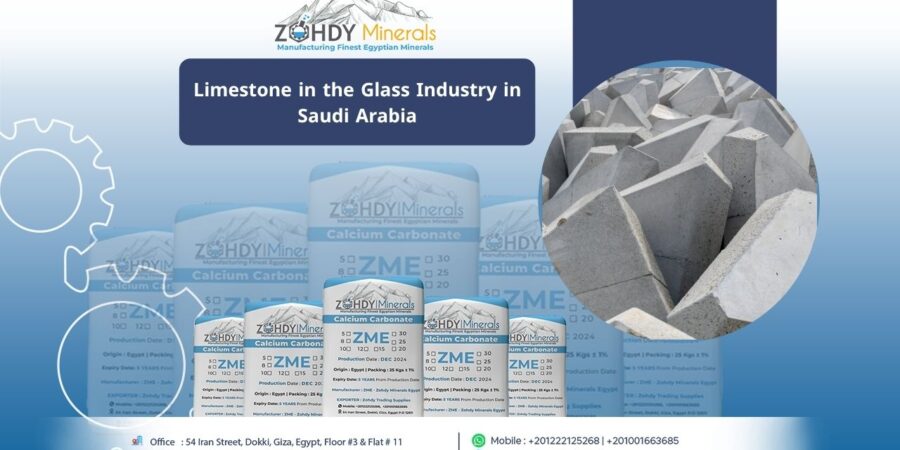
The batch may also sometimes contain recycled crushed glass (cullet). Lime is usually added in the form of limestone (calcium carbonate (CaCO3), which is decomposed inside the glass furnaces to release lime and carbon dioxide (CO2).
Why is Limestone Used in Saudi Arabia from Zohdy Minerals Egypt?
Despite the ability to use lime directly, limestone is generally preferred because it is less expensive and has proven to be high-quality and effective over time.
Each of the three main components plays a specific and important role:
- Silica: Forms the glass structure but requires a very high melting point (over 1710C)
- Soda: Acts as a fluxing agent to reduce the melting point, but the glass weakens and becomes soluble in water.
- Limestone: Helps to stabilize the glass, imparting hardness and chemical durability and preventing it from dissolving in water.
In addition, limestone helps to reduce the viscosity of the molten glass, making it easier to shape. It also reduces the risk of undesirable crystallization which can cause clouding and defects in the glass.
What Are the Types of Limestone?
There are two main types of limestone:
- High-Calcium Limestone: Primarily consists of (CaCO3) with a low percentage of impurities (1-3%).
- Dolomitic Limestone: Contains 35-45% magnesium carbonate ($\text{MgCO}_3$ ), with the remainder being primarily (CaCO3).
The choice of type depends on the kind of glass being produced:
- Flat Glass (e.g., windows): Dolomitic Limestone is often preferred to reduce clouding and crystallization during the slow cooling process.
- Container Glass (e.g., bottles): High-Calcium Limestone is preferred because cooling is faster and less prone to defects.
- Fiberglass: Dolomitic is frequently used, depending on the required fiber properties.
If you need to obtain limestone in Saudi Arabia, you should contact us, Zohdy Minerals Egypt.
Importance of Quality Consistency
Limestone consists of essential elements: calcium, magnesium, iron, and silica.
- Calcium and Silica: Their presence is vital for glass manufacturing.
- Magnesium: Has several benefits, especially as mentioned earlier (in dolomitic limestone).
- Iron: Considered the most important limestone impurity, as it changes the color of the glass (which is beneficial in some types such as colored or amber glass).
Also, the particle size of the limestone is very important:
- Very large particles increase the melting time and cause solids to remain in the glass.
- Very fine particles may accelerate melting and lead to the formation of air bubbles inside the glass.
The ideal moisture content for limestone is about 5%, which helps control dust without negatively affecting the process.
The Future of Limestone in Saudi Arabia
The glass industry is constantly evolving, with developments in areas such as:
- Solar panels.
- Smart glass.
- Optical fibers for telecommunications.
- Environmental filtration systems.
All of this requires the development of raw materials to meet diverse customer needs while ensuring energy efficiency and reducing emissions.
As an expert in the production and use of lime and limestone, Zohdy Minerals Egypt provides you with products of consistent quality and a reliable distribution network.
Zohdy Minerals Egypt also has experts who assist customers in selecting the optimal type of limestone in line with their specific industrial requirements across different fields. contact us.