
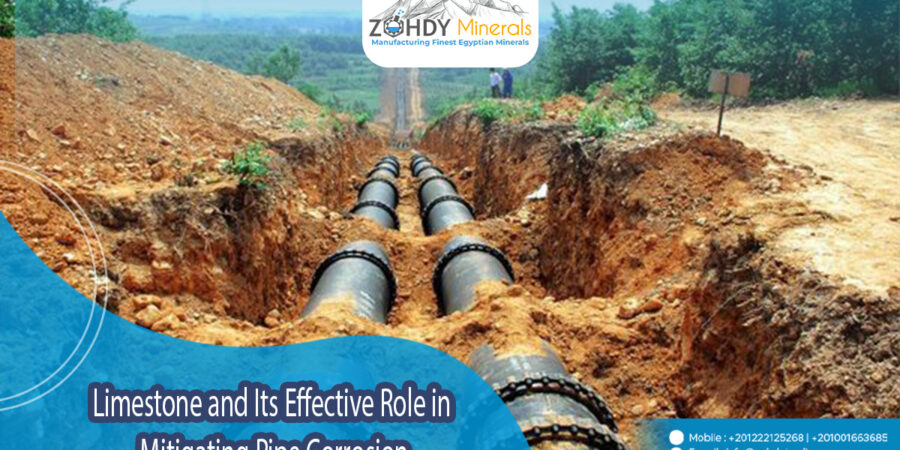
Corrosion in piping systems is one of the most significant challenges facing water distribution networks and various industries globally,Corrosion doesn’t just damage the physical infrastructure; it impacts operational costs, transport efficiency, and water quality.
Among the natural and effective solutions, limestone emerges as an ideal choice due to its unique properties that scientifically mitigate internal pipe corrosion.
Limestone and Its Effective Role in Mitigating Pipe Corrosion, possesses a natural ability to adjust water pH levels, reducing the activity of harmful ions that accelerate the corrosion process.
When used in powder form or through a process known as “slurrying,” it can be distributed evenly within pipes to form a protective layer that acts as a barrier between the water and the metal pipe wall.
This layer not only prevents corrosion but also improves water quality by reducing harmful mineral deposits, ensuring operational continuity with maximum efficiency and minimum cost.
Understanding Internal Pipe Corrosion and Its Causes
Internal pipe corrosion is the gradual degradation of metal due to chemical or electrochemical reactions between the metal surface and the water or chemicals flowing through it.
This degradation weakens pipes, shortens their lifespan, and can lead to total system failure. Key causes include:
-
Acidic Water (Low pH): Increases the rate at which metals react with the environment.
-
Accumulation of Dissolved Salts and Minerals: Accelerates chemical corrosion and forms harmful scales.
-
Fluctuating Flows and High Pressure: Causes additional mechanical erosion on pipe walls.
-
Industrial Chemical Additives: These may react with metals, increasing the corrosion rate.
Why Limestone is an Effective Solution
Limestone, rich in Calcium Carbonate (CaCO3), offers natural properties capable of protecting pipes:
1. pH Adjustment:
The Calcium Carbonate in limestone raises the pH of acidic water, neutralizing it. This adjustment significantly slows down the chemical corrosion process by reducing the activity of acidic ions that attack metal surfaces. This leads to chemical stability within the pipes, preventing the development of micro-cracks.
2. Formation of a Protective Coating:
One of the most vital benefits of limestone is its ability to form a thin, protective carbonate film on the metal surface.
This barrier prevents direct contact between the water and the metal.
Over time, this layer becomes denser and smoother, reducing hydraulic friction, improving flow, and extending the network’s lifespan.
3. Precipitation of Harmful Ions:
Water often contains iron, magnesium, and dissolved salts that catalyze corrosion.
Limestone helps precipitate and stabilize these ions, protecting the pipes from continuous chemical attack and improving the quality of transported water—a critical factor for drinking water and food industries.
4. Mitigating Mechanical Erosion:
While mechanical erosion is caused by friction and pressure, the protective limestone layer acts as a buffer, reducing direct friction between high-velocity water/particles and the pipe wall.
Limestone and Its Effective Role in Mitigating Pipe Corrosion
-
Drinking Water Treatment: Adding limestone powder to treatment tanks to maintain chemical stability.
-
Industrial Wastewater Networks: Using limestone treatment units to neutralize the impact of industrial chemicals on metal pipes.
-
Industrial Cooling and Heating Systems: Protecting systems from rapid corrosion caused by acidic or ion-rich water.
Real-World Impact
-
Urban Water Networks: Studies show that integrating limestone into water treatment can reduce pipe corrosion rates by up to 40% over five years.
-
Chemical Plants: Its use helps reduce the need for expensive pipe replacements and minimizes production downtime.
-
Central Heating Systems: The protective layer formed maintains heat transfer efficiency and lowers maintenance requirements.
Economic and Environmental Benefits
-
Extended Infrastructure Lifespan: Reducing corrosion rates preserves the network and delays costly replacements.
-
Operational Cost Savings: Fewer repairs and maintenance tasks improve resource management efficiency.
-
Enhanced Water Quality: Precipitating minerals and protecting pipes results in cleaner, safer water.
-
Eco-Friendly Solution: Reduces reliance on harsh chemicals, ensuring environmental protection.
Choosing the Right Limestone
The effectiveness depends on:
-
Purity Level: A higher Calcium Carbonate content ensures better protection.
-
Particle Size: Fine particles react faster, while larger granules provide long-term protection.
-
Water Usage Conditions: The required quantity varies based on water acidity and flow rates.
Limestone and Its Effective Role in Mitigating Pipe Corrosion, By adjusting pH, forming protective barriers, and precipitating harmful ions, it protects water infrastructure naturally and effectively.
Investing in high-quality limestone is a long-term commitment to sustainability and equipment protection.
To meet these challenges, Zohdy Minerals Egypt provides high-quality limestone solutions designed to ensure the durability of water networks and protect industrial infrastructure across the Saudi market and the region, Contact us.