
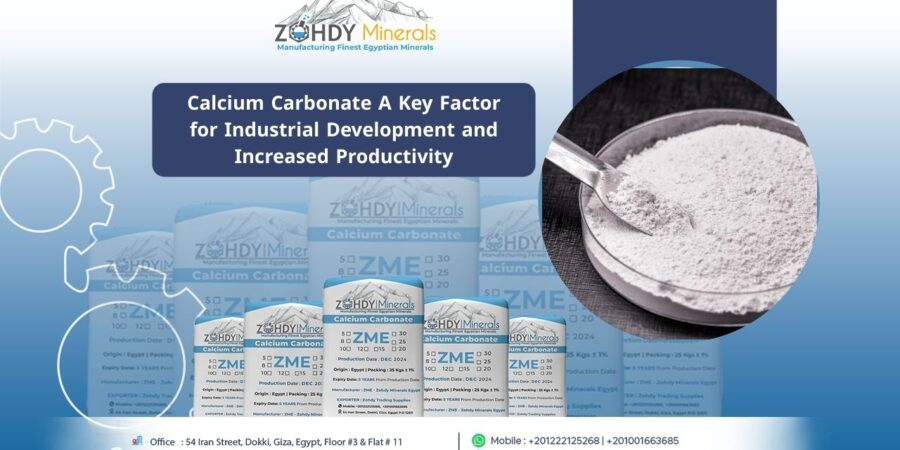
Calcium Carbonate (CaCO) is considered one of the important natural materials that plays a pivotal role in many modern industries.
Thanks to its unique chemical and physical properties, this material is used to improve product quality and reduce production costs in diverse fields such as paints, plastics, paper, and others.
Although its industrial importance is high, the extraction of calcium carbonate relies on mining, a natural process associated with obtaining this vital material sustainably.
In this article, we will explore the most prominent uses and multiple benefits of calcium carbonate in industry, Zohdy Minerals Egypt offers its services in this field to ensure the provision of high-quality calcium carbonate.
What is Calcium Carbonate?
Calcium Carbonate is a chemical compound with the formula (CaCO3), It consists of three main elements (Carbon, Oxygen, and Calcium) and typically appears as a white powder. It is one of the most common chemical compounds on Earth’s surface and is found in many rocks and minerals, including limestone, chalk, and marble.
It is a very common material found in rocks worldwide (especially as limestone), and it is also the main component of the shells of marine organisms, snail shells, cuttlefish bones, pearls, and eggshells.
Advantages of Calcium Carbonate
-
Abundant Availability: Calcium carbonate is found in many rocks worldwide, making it easily accessible and usable.
-
Versatility: Calcium carbonate is used in a wide range of industries, including construction, agriculture, and manufacturing.
-
Environmentally Safe: Calcium carbonate is considered a non-toxic material that does not harm the environment.
Uses of Calcium Carbonate
Calcium carbonate is used in a wide range of industries due to its unique properties that enhance product quality and lower costs:
- Paper and Pulp Industry: Calcium carbonate works to improve paper smoothness, increase its stiffness, and enhance print quality.
-
Plastics Industry: It contributes to enhancing strength and durability and reducing production costs.
-
Paints and Coatings: Calcium carbonate helps improve color coverage and imparts a higher sheen and quality to surfaces.
-
Adhesives and Sealants: It enhances material adhesion and improves performance.
-
Rubber Industry: Used to increase flexibility and durability and improve physical properties.
-
Food and Beverages: Its benefits extend to food and beverages to enhance nutritional value and added calcium.
-
Pharmaceuticals and Cosmetics: Used to improve texture, quality, and safety of use.
Benefits of Using Calcium Carbonate in Industry
-
Improved Quality of final products and increased durability.
-
Reduced Raw Material Cost when used as a filler.
-
Support for Environmental Sustainability when using natural calcium carbonate.
-
Calcium carbonate is a fundamental material in many modern industries, helping to improve quality and lower costs.
Calcium Carbonate and the Fertilizer Industry
The fertilizer industry is one of the most important industries globally, playing an essential role in increasing agricultural productivity and improving crop quality.
Calcium Carbonate (CaCO3) is one of the most important raw materials used in the fertilizer industry for the following reasons:
-
High Availability: Calcium carbonate occurs naturally in many rocks and sediments, making it available in large quantities and at reasonable prices.
-
Chemical Properties: Calcium carbonate has chemical properties suitable for the fertilizer industry as it is reactive with acids to form calcium salts, which are essential nutrients for plants.
Types of Fertilizers that Use Calcium Carbonate
-
Nitrogen Fertilizers: Calcium carbonate reacts with ammonia to form Calcium Nitrate fertilizer, one of the most important sources of nitrogen for plants.
-
Phosphorus Fertilizers: Calcium carbonate reacts with phosphoric acid to form Calcium Superphosphate fertilizer, one of the most important sources of phosphorus for plants.
-
Potassium Fertilizers: Calcium carbonate reacts with potassium chloride to form Potassium and Calcium Chloride fertilizer, one of the most important sources of potassium for plants.
Importance of Calcium Carbonate (CaCO3) in the Fertilizer Industry
Calcium carbonate contributes to the fertilizer industry by providing essential nutrients for plants, and it also helps to:
-
Improve Soil Structure: Calcium carbonate contributes to improving soil structure and making it more fertile due to its ability to bind soil particles together.
-
Neutralize Soil Acidity: Calcium carbonate can be used to neutralize soil acidity (liming), which helps to improve plant growth and increase productivity.
Natural (GCC) vs. Precipitated (PCC) Calcium Carbonate
The main difference between Precipitated Calcium Carbonate (PCC) and Ground Calcium Carbonate (GCC) lies in their production method and properties. GCC is a natural product obtained by crushing limestone or marble, while PCC is a manufactured product created through a precise chemical process.
Ground Calcium Carbonate (GCC)
-
Definition: The form of calcium carbonate obtained directly from natural sources such as limestone, marble, and chalk. It is also known as GCC and is widely used in industries that rely on high-purity, white raw materials.
-
Production: GCC is extracted from rocks like limestone and marble, then ground (milled) for industrial use.
-
Chemical Formula: The chemical formula is CaCO3.
-
Properties:
-
High purity, making it ideal for sensitive industries.
-
Chemical stability; resistant to chemical reactions.
-
Good dispersibility, making it easy to integrate into products.
-
High opacity/brightness (whiteness), used in paper and paints to improve color and brightness.
-
Precipitated Calcium Carbonate (PCC)
-
Definition: A material resulting from a chemical reaction between calcium hydroxide and carbon dioxide. It is known as PCC and is used particularly when a high-purity and uniform particle size product is required.
-
Production: PCC is produced industrially by dissolving calcium oxide (lime) in water and then passing carbon dioxide through it to obtain precipitated calcium carbonate crystals.
-
Properties:
-
Finer particle size and uniform crystalline shape.
-
Higher purity than GCC.
-
Greater control over physical and chemical properties.
-
Calcium carbonate is one of the most important versatile natural materials that plays a pivotal role in various industries such as paper, plastics, paints, rubber, fertilizers, and pharmaceuticals.
It contributes to improving product quality, increasing durability, and reducing production costs.
With the increasing need for high-quality and sustainable raw materials, Zohdy Minerals Egypt offers integrated services to ensure the supply of pure, high-performance calcium carbonate that reliably meets the needs of modern industries. Contact Us.