
In the era of modern manufacturing, natural raw materials are no longer just basic inputs; they have become a decisive factor in determining the quality, efficiency, and lifespan of the final product.
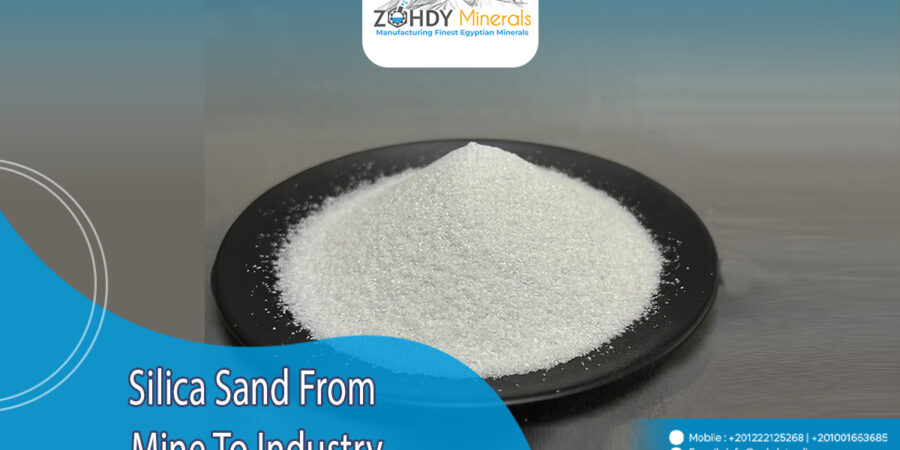
Silica Sand From Mine to Industry: Among these resources, silica sand emerges as one of the most vital minerals upon which numerous industrial sectors rely. Precise purity and high-quality sorting play a fundamental role in elevating the value of this sand, transforming it from mere natural grains into a strategic material essential for glass, metallurgy, electronics, chemicals, and more.
In this context, Zohdy Minerals Egypt stands out as a leading exporter dedicated to providing high-quality silica sand to various markets, foremost among them the Saudi Arabian market.
Understanding Silica Sand From Mine to Industry
Silica sand is a type of natural sand characterized by a high concentration of silicon dioxide ().
It primarily consists of quartz grains resulting from the erosion of rocks over millions of years.
Its significance lies in its unique physical and chemical properties, such as high hardness, thermal resistance, chemical stability, and exceptional color clarity.
These characteristics make silica sand indispensable in several industries, including glass manufacturing, metal casting, ceramics, water filtration, and even precision medical and technological applications.
The Importance of Silica Sand Purity in Industry
Silica Sand From Mine to Industry, Purity is the most critical factor in determining the industrial value of silica sand, As the percentage of silicon dioxide increases and impurities—such as iron, aluminum, and clay—decrease, the quality and suitability of the sand for sensitive applications improve.
For instance, the glass industry requires high-purity sand to ensure transparency and prevent color defects. Similarly, the electronics industry depends on ultra-pure silica for precise performance.
Silica Sand From Mine to Industry, Even minor impurities can cause discoloration, weaken structural integrity, or lower thermal resistance.
Therefore, measuring and controlling purity is a vital step in industrial production chains:Silica Sand From Mine to Industry.
Measuring Silica Sand Purity
The process of measuring purity involves several rigorous stages using advanced analytical techniques. It begins with taking representative samples for laboratory testing. The primary test determines the exact percentage of silicon dioxide. Subsequently, iron oxide levels are measured, as iron directly impacts the color of the final product, especially in glass. Other elements like alumina, calcium, and magnesium are also analyzed for their effects on thermal and chemical properties. Additionally, Grain Size Distribution (GSD) is analyzed, as specific industries require precise grain sizes—ranging from fine to coarse—to suit their applications.
Analytical Equipment and Precision
Modern laboratories utilize sophisticated equipment for high-precision analysis.
Key instruments include:
-
X-Ray Fluorescence (XRF): Used to determine the chemical composition with great accuracy.
-
Atomic Absorption Spectroscopy (AAS): Used to measure the concentration of metallic elements with extreme precision. These devices eliminate guesswork, providing clear numerical results that guide classification, pricing, and industrial use.
The Significance of Precise Sorting
Precise sorting is the second phase after confirming purity and is equally important.
Even high-purity sand may be unsuitable for certain uses if the grain size is inconsistent.
Sorting involves separating grains by size using mechanical screens, vibrating separators, or advanced pneumatic systems.
Accurate sorting ensures size uniformity, which facilitates mixing, molding, and melting processes, thereby increasing production efficiency and reducing waste or equipment failure.
Purity, Sorting, and Final Product Quality
There is a direct correlation between purity, sorting precision, and final product quality. Pure sand that is poorly sorted can cause production line disruptions due to inconsistent grain sizes. Conversely, well-sorted sand with low purity can compromise the chemical and thermal properties of the product. Achieving the highest quality requires the synergy of both factors, leading to an ideal raw material that improves energy efficiency and extends equipment life.
Impact on Various Industries
-
Glass Industry: Ensures a homogeneous melt free of bubbles and defects.
-
Foundry and Casting: Enhances heat distribution and the smooth flow of molten metal into molds.
-
Water Filtration: Guarantees higher filtration efficiency in removing impurities.
-
Chemical Industry: Plays a role in reaction speed and result consistency.
Global Standards for Silica Sand
Leading companies adhere to strict international standards (such as European and American standards) that define permissible impurity levels and grain size limits. Compliance with these standards protects equipment, reduces operational costs, and serves as a certificate of trust between suppliers and manufacturers.
Challenges in Measurement and Sorting
Despite technological progress, challenges remain, such as variations in sand characteristics from one mine to another and natural impurity fluctuations. Continuous maintenance and calibration of equipment are essential to ensure results remain accurate.
The Future of Silica Sand
With the expansion of green energy and high-tech industries, demand for high-purity silica is surging. For example, solar panel manufacturing relies on ultra-pure silica for maximum energy conversion efficiency. It is also essential for fiber optics and semiconductors, positioning it as a pillar of the future industrial economy.
Investing in Quality: The Path to Success
Investing in advanced analysis and sorting systems is no longer a luxury but a necessity for competition. True quality begins with the raw material. Silica sand is a clear example of how purity and sorting determine the entire future of a product.
In this regard, Zohdy Minerals Egypt continues its pivotal role in exporting high-quality silica sand to the Saudi market, supporting industrial growth and reinforcing confidence in regional products through a commitment to international standards and modern technology. Contact Us.