
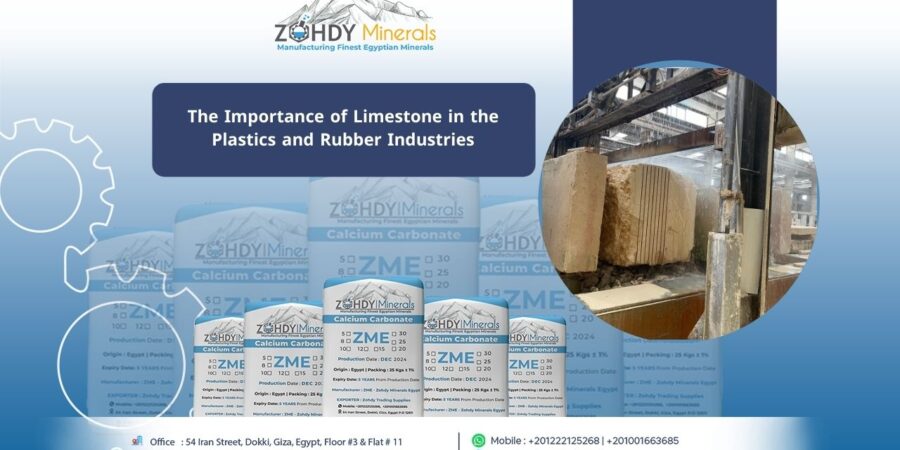
Limestone in the Plastics and Rubber Industries is one of the most important natural mineral raw materials used in many modern industries, most notably the plastics and rubber industries.
With rapid development in production sectors, reliance on natural materials that improve product quality, reduce manufacturing costs, and adhere to environmental standards has increased.
Because limestone is characterized by diverse chemical and physical properties and is available in large quantities, it has become a key component in the manufacturing of hundreds of plastic and rubber products.
In this article, we present the importance of limestone in the plastics and rubber industries, how it is used, the benefits it offers, and its role in enhancing mechanical properties and reducing costs.
We also cover its environmental impact and the challenges associated with its use.
Zohdy Minerals Egypt is committed to applying the highest quality standards at all manufacturing stages to ensure products comply with the requirements of the Saudi market.
For more details Contact Us.
What is Limestone and Why is it Used Industrially?
Limestone is a sedimentary rock primarily composed of Calcium Carbonate ().
It is a white material with a soft texture that is easy to grind and can be converted into fine or micronized powder suitable for sensitive industrial uses such as the plastics and rubber industries.
Properties of Calcium Carbonate that Make it Ideal for Industry:
-
Pure White Color: Grants plastic products an attractive appearance.
-
Fineness and Grindability: Can be ground to various sizes, ranging from micron to nano scales.
-
Chemical Stability: Makes it non-reactive with chemicals or normal temperatures.
-
Moderate Hardness: Allows it to support the product without causing negative effects.
-
Very Low Cost: Compared to other industrial filler materials.
These properties have made limestone an ideal filler material in many industries, especially plastics and rubber.
Limestone in the Plastics Industry
In the plastic manufacturing field, limestone is used as finely ground calcium carbonate with high purity and precision grades.
It is incorporated into the manufacturing of many types of plastics, such as:
-
Polyvinyl Chloride (PVC)
-
Polypropylene (PP)
-
Polyethylene (PE)
-
Engineering Plastics
-
Plastics used in packaging, bags, pipes, industrial textiles, and more.
1. Improving the Mechanical Properties of Plastic
Calcium carbonate derived from limestone helps in:
-
Increasing rigidity and stiffness.
-
Increasing tensile strength and compressive strength.
-
Improving thermal stability.
-
Reducing shrinkage during cooling.
-
Controlling viscosity during molding and melting processes. These factors make the plastic product stronger, more durable, and more resistant to heavy use.
2. Reducing Production Costs
Calcium carbonate constitutes about 40–60% of the weight of many plastic products because it:
-
Is much cheaper than petroleum-based polymers.
-
Reduces the consumption of the primary raw material.
-
Requires less energy in the plastic processing operation. Thus, it contributes to reducing the final cost of the product without affecting quality.
3. Enhancing Color and Surface Quality
Limestone powder is used to increase:
-
The degree of whiteness.
-
The level of gloss.
-
The quality of the final surface appearance of the product. This is important in industries that require high aesthetics, such as household goods, plastic furniture, and toys.
4. Boosting Heat Resistance
Calcium carbonate helps to:
-
Increase the plastic’s ability to withstand heat.
-
Improve its performance during printing and molding processes.
-
Reduce the material’s shrinkage rate when exposed to heat, minimizing the possibility of cracking or warping.
5. Increasing Specific Gravity
In certain industries, such as plastic pipe manufacturing or internal car parts, limestone helps increase the weight to the required amount without using more expensive materials.
The Importance of Limestone in the Rubber Industry
Limestone is also a key component in the rubber industry, both natural and synthetic.
It is used in the manufacturing of:
-
Car tires.
-
Footwear and sports equipment.
-
Synthetic rubber products.
-
Conveyor belts.
-
Rubber products for sound and heat insulation.
-
Rubber gloves.
-
Pipes and hose systems.
Filler Material to Enhance Rubber Strength:
Calcium carbonate is used as a filler material that helps to:
-
Increase durability and elasticity.
-
Improve tear resistance.
-
Reduce abrasion.
-
Improve rheological properties during manufacturing. The higher the quality of the limestone powder, the greater the strength of the rubber product.
Controlling Rubber Viscosity:
Limestone helps control viscosity during the rubber production process, which facilitates:
-
Mixing
-
Shaping
-
Casting
-
Vulcanization This is a critical factor in ensuring homogeneous, high-efficiency rubber.
Improving Heat and Pressure Resistance:
Calcium carbonate works to:
-
Reduce the rubber’s heat absorption.
-
Increase its resistance to pressure and abrasion.
-
Extend the product’s lifespan.
-
Enhance its stability at varying temperatures. This has made limestone an essential component in the manufacturing of high-quality car tires.
Lowering the Final Cost:
As in the plastics industry, limestone helps to:
-
Reduce the overall cost of the rubber product.
-
Replace a large part of expensive polymers.
-
Improve the economic efficiency of factories. Thus, the rubber becomes more competitive in the markets.
Grades of Limestone in Industries
The grades of calcium carbonate used in plastics and rubber differ based on:
-
Chemical purity
-
Particle size
-
Whiteness degree
-
Hardness and fineness level
Most Used Grades:
-
2 Micron
-
1 Micron
-
Nano Calcium Carbonate
Grades below 2 microns are typically used in:
-
PVC
-
Plastic transparencies
-
Fine rubber products
While larger grades are used in:
-
Rigid plastic products
-
Pipes
-
Plastic furniture
Environmental Effects of Using Limestone
Due to the criticism facing petroleum and plastic industries, manufacturers are always looking for environmentally friendly options. Limestone, being a natural and harmless material, offers key environmental advantages:
-
Natural, Non-Toxic Material: Does not release harmful substances during manufacturing or use.
-
Recyclable: Products containing limestone can be recycled easily.
-
Reduced Carbon Emissions: Because it lessens the industry’s reliance on petroleum polymers.
-
Reduced Waste: Limestone is used to improve the quality of recycled used plastic.
Challenges Associated with Using Limestone
Despite the significant benefits of limestone, there are some challenges:
-
The need for high purity grades to avoid impurities that affect quality.
-
The high cost of fine grinding to micron or nano grades.
-
The impact of inappropriate size may weaken product quality.
-
The need for precise adjustment during mixing to ensure complete homogeneity.
However, these challenges are easily solved using modern grinding and processing technologies.
Future of Limestone Use in Polymer Industries
Experts expect the role of limestone to continue rising in the coming years due to:
-
High demand for low-cost plastic.
-
The need for environmentally friendly materials.
-
Industrial expansion in developing countries.
-
Advances in nano calcium carbonate technologies.
Limestone derivatives are expected to be integrated into:
-
3D Printing.
-
Bioplastics.
-
Advanced thermal insulation systems.
-
Advanced composites in electric vehicles.
Limestone is one of the most essential raw materials in the plastics and rubber industries, given its economic, mechanical, and environmental benefits.
It is a strong filler that improves the quality and durability of products, reduces cost, and increases their ability to withstand various environmental conditions.
With the rapid development in calcium carbonate processing techniques, limestone plays an even greater role in bolstering polymer industries.
Thanks to its large availability and diverse properties, limestone will remain an indispensable element in the development of the plastics and rubber industries now and in the future.
For inquiries or to place an order, you can contact the Zohdy Minerals Egypt team to get offers and export services to the Saudi market. Contact Us.