

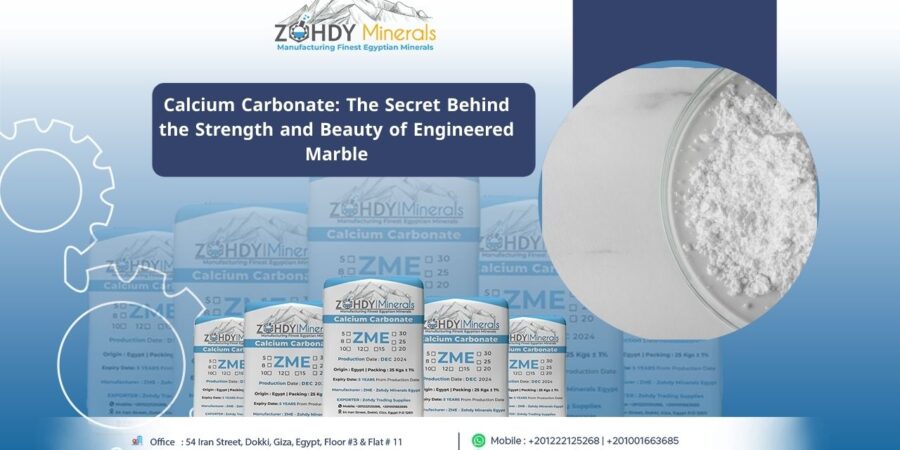
High-quality Calcium Carbonate grants engineered marble exceptional hardness and natural-like luster, alongside excellent resistance to wear and scratches, efficiently meeting your industry’s needs.
The engineered marble industry is witnessing rapid growth to meet the increasing demand for elegant and durable surfaces in homes and major commercial projects.
Selecting the right raw materials is the critical factor in determining the marble’s quality, and Calcium Carbonate is paramount among these materials.
It not only provides the marble with exceptional hardness but also adds a shine and smoothness resembling natural marble, which elevates its aesthetic and functional value. Calcium Carbonate also plays a vital role in enhancing the marble’s resistance to wear and scratches, making the final product significantly more durable and long-lasting.
Thanks to these characteristics, Calcium Carbonate has become an essential component in high-quality engineered marble manufacturing, making it the optimal choice for industries aiming to deliver products that combine both beauty and strength.
At Zohdy Minerals Egypt, dear client, we guarantee the provision of Calcium Carbonate that adheres to the highest quality standards, meeting the needs of the marble industry and other sectors relying on this crucial material.
The Role of Calcium Carbonate in the Engineered Marble Industry
- Structural Reinforcement:This material significantly contributes to the structural hardness and durability of engineered marble, making the final product more capable of withstanding pressure and external factors compared to other materials.
- Surface Property Enhancement:Calcium Carbonate helps improve the smoothness and luster of the engineered marble surface, giving the product an appearance similar to natural marble and increasing its consumer appeal.
- Cost Reduction:This material plays an important economic role in reducing production costs. It is used as an economical filler that lessens the need for other, more expensive raw materials.
- Coloring and Homogeneity:Thanks to its pure white color, this material provides a uniform base that aids in the homogeneous distribution of colors within the material, making the engineered marble more visually appealing and consistent.
- Chemical Reaction:In some applications, this material engages in reactions with binding agents, such as polyester resins, to enhance the cohesion between the product’s components and increase its hardness.
Key Features of Calcium Carbonate
Calcium Carbonate is distinguished by a set of important properties that make it one of the most widely used materials across various industries. Its importance stems from a unique combination of physical and chemical attributes that grant products higher quality and better efficiency, such as:
- Abundance and Low Cost:Limestone is abundant in nature, making it an economical material suitable for reducing production costs.
- Pure White Color:The white color of Calcium Carbonate is a key advantage in industries that require an attractive aesthetic appearance, such as the paints, plastics, and engineered marble industries.
- Diverse Chemical Reactivity:This material has the ability to react with a range of chemical substances, enhancing its use in applications that require improved cohesion between components.
- Hardness and Durability:Calcium Carbonate contributes to enhancing the strength and durability of products, increasing their lifespan and resistance to external factors.
- Customizability:The size of Calcium Carbonate particles can be controlled to suit various industries and uses.
Composition of Calcium Carbonate and its Main Natural Forms
This material is a chemical compound with the formula CaCO_3 and is extracted from natural sources such as limestone, marble, and chalk. This compound is characterized by its chemical stability and ease of reaction in many industrial processes.
It also has several other names used in different contexts, including:
-
Limestone: When present in nature as a rock.
-
Chalk: When the material is soft and porous.
-
Aragonite: One of the crystalline forms of this material.
-
Calcite: The most common crystalline mineral form of this material.
-
Carbonate of Lime: Sometimes used to refer to it in certain industries.
The Role of Calcium Carbonate in Strengthening Building Materials and Improving Their Performance
The role of Calcium Carbonate in the building materials industry is significant and central, given its use in many construction applications and its distinct set of benefits, including strength, stability, and cost-effectiveness, such as:
-
Cement: Calcium Carbonate is the main component in Portland cement, where it reacts with aluminum oxide and iron oxide in lime to form solid compounds that bind sand and gravel.
-
Bricks: Calcium Carbonate is used in the manufacturing of bricks and compressed cement, helping to increase their strength and stability.
-
Quicklime: Quicklime, a form of Calcium Carbonate, is used in the manufacturing of concrete building materials such as lime cement and lime.
-
Slaked Lime: Slaked lime, another form of Calcium Carbonate, is used in the manufacturing of lime-based building materials such as plaster and gypsum.
-
Tiles: Calcium Carbonate is used in tile manufacturing, helping to increase their hardness and appearance.
-
Sealants: Calcium Carbonate is used in the manufacturing of sealants, helping to prevent water leakage.
-
Insulation Materials: Calcium Carbonate is used in the manufacturing of insulation materials, helping to provide thermal, acoustic, and moisture insulation, as follows:
-
Thermal Insulation: Calcium Carbonate is used in the manufacturing of thermal insulation materials, helping to prevent heat loss from buildings.
-
Acoustic Insulation: Calcium Carbonate is used in the manufacturing of acoustic insulation materials, helping to prevent sound transmission from outside to inside.
-
Moisture Insulation: Calcium Carbonate is used in the manufacturing of moisture insulation materials, helping to prevent moisture seepage into buildings.
-
-
Adhesive Materials: Calcium Carbonate is an important building material that plays a key role in the production of construction adhesives, helping to increase their strength and stability, and is used as a basic component in a variety of products.
-
Tile Adhesives: Tile adhesives are used to install tiles on walls and floors. Calcium Carbonate is used in the manufacturing of tile adhesives as a basic component, contributing to their strength and stability.
-
Ceramic Adhesives: Ceramic adhesives are used to install ceramics on walls and floors. Calcium Carbonate is used in the manufacturing of ceramic adhesives as a basic component, contributing to their strength and stability.
-
Flooring Adhesives: Flooring adhesives are used to install hard floors such as wood and stone.
Main Benefits of Using Calcium Carbonate in Building Materials Manufacturing
-
Strength: Calcium Carbonate increases the strength and stability of building materials such as cement and bricks, and the strength and stability of construction adhesives, providing them with structural strength and contributing to the adhesives’ water resistance, preventing water seepage into the adhesives.
-
Stability: Calcium Carbonate increases the stability of building materials such as cement and bricks, and the stability of construction adhesives.
-
Cost: Calcium Carbonate is a low-cost building material.
-
Availability: Calcium Carbonate is a readily available building material.
Calcium Carbonate represents the cornerstone of many modern industries, ranging from engineered marble to various types of building materials.
Thanks to its unique properties—hardness, pure whiteness, and the ability to enhance cohesion between components—this material has become indispensable for every manufacturer seeking to produce durable, aesthetic, and high-efficiency products.
With the growing demand for products that combine quality with appropriate cost, Calcium Carbonate remains the premier choice for numerous industrial sectors.
At Zohdy Minerals Egypt, we are committed to delivering Calcium Carbonate with the highest quality standards and consistent specifications tailored to the needs of manufacturers and various production line requirements.
Our goal is to be your trusted partner, providing you with raw materials that enhance your product quality and strengthen your competitive edge in the market. Contact Us.