

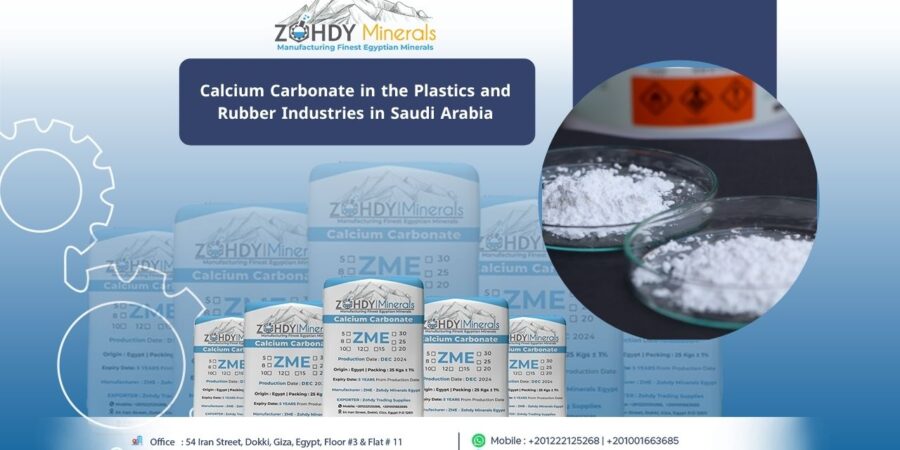
Calcium carbonate (CaCO3) is a widely used additive in the plastics and rubber industries in Saudi Arabia, helping to improve the properties of both materials. The uses of calcium carbonate in these industries are numerous, as it helps increase the strength and durability of rubber and plastic products.
Calcium carbonate is also a cost-effective filler that reduces overall production costs. Furthermore, it can enhance these materials in terms of ease of molding and shaping.
Calcium carbonate can be used in the Saudi plastics and rubber industries for automotive parts and household products. Calcium carbonate is a vital material that helps elevate the performance and sustainability of rubber and plastic products.
If you need to obtain calcium carbonate for the plastics and rubber industries in Saudi Arabia, you should contact us at Zohdy Minerals Egypt.
Using Calcium Carbonate in Plastics in Saudi Arabia
Calcium carbonate acts as a type of skeleton structure in plastic products, which significantly enhances dimensional stability.
Calcium carbonate also improves the product’s rigidity, electrical performance, flame resistance, heat resistance, and processing performance. It also works to improve surface gloss and uniformity through Zohdy Minerals Egypt in Saudi Arabia.
When added, calcium carbonate raises the heat resistance in standard plastic products. Since its whiteness exceeds 90%, it can serve as a substitute for costly white pigments.
For Example, in the manufacturing of PVC products:
- The proper use of Heavy Calcium Carbonate can improve heat resistance, rigidity, dimensional stability, and processability.
- Using small amounts of Light Calcium Carbonate (PCC) helps increase the tensile strength of PVC products.
However, caution must be exercised:
- Using excessively large quantities of calcium carbonate additives in PVC products may lead to quality degradation.
- Using poor-quality calcium carbonate can significantly reduce the quality of the final product.
- Adding the same quantities of normal, high-quality, or poor-quality calcium carbonate leads to significant differences in final performance.
Calcium Carbonate in the Rubber Industry
Calcium carbonate plays a dual role in the rubber industry: a reinforcing agent and an economical filler material.
- Increases Flexibility and Strength: Calcium carbonate enhances the flexibility and abrasion resistance of rubber products, making it ideal for applications like tires, belts, and gaskets.
- Increases Volume Without Significant Weight: While adding volume to rubber compounds, it does not cause a significant increase in weight, resulting in products that are lighter and stronger.
- Improves Processability: Due to its fine particles, it distributes better within the rubber matrix, improving homogeneity and ease of processing.
- Reduces Overall Costs: It lowers the consumption of high-cost rubber polymers, which reduces the cost of production and increases profitability.
Understanding the Properties of Calcium Carbonate (CaCO3) in the Rubber Industry
Calcium carbonate plays a key role in enhancing the mechanical strength, processability, and overall performance of rubber products.
1. Lowering the Melting Point in Mixtures
(Note: This section seems to describe glass manufacturing, which is usually separate from rubber, but the translation is provided as written.)
- The main component of glass is silica sand (SiO2), which melts at a high temperature (around $1700C).
- When calcium carbonate is added to silica, a mixture called raw glass is formed.
- At high temperatures, calcium carbonate reacts with silica to form new compounds with a significantly lower melting point (800$ – $900$).
- This allows for glass manufacturing with higher efficiency and lower energy consumption.
2. Improving Rubber Properties
- Strength: Calcium carbonate increases the rubber’s wear and tear resistance.
- Hardness: It affects the rubber, making it harder and more durable.
- Chemical Resistance: It improves the rubber’s resistance to various chemicals.
- Heat Resistance: It enhances the rubber’s ability to withstand high temperatures.
3. Facilitating Processing
- Calcium carbonate reduces the viscosity of the rubber, which makes the mixing and shaping process easier.
- It shortens the mixing time, increasing production efficiency.
- It improves moldability, facilitating the manufacturing of diverse rubber products.
4. Types of Calcium Carbonate in the Rubber Industry
- Heavy (Ground) Carbonate (GCC): Used in products that require strength and hardness, such such as footwear.
- Light (Precipitated) Carbonate (PCC): Used in rubber products that require high flexibility, such as tires.
5. Quantity of Calcium Carbonate Used
- The ratio is determined and varies depending on the product type.
- The proportion of calcium carbonate in the rubber industry ranges between 10% and 50%.
6. Effect of Calcium Carbonate on Rubber Properties
- Hardness: Increases hardness and resistance to scratching and abrasion.
- Heat Resistance: Improves the rubber’s ability to operate at high temperatures.
- Tensile Strength: Improves the rubber’s ability to withstand heavy loads.
- Fatigue Resistance: Reduces the rate of fatigue, which extends the product’s lifespan.
- Chemical Resistance: Increases its resistance to acids and bases.
7. Applications in the Rubber Industry
- Tires: To enhance strength and wear resistance.
- Footwear: Increases hardness and durability.
- Other Products: Such as hoses, gaskets, and rubber sheets.
8. Environmental Impact
- Calcium carbonate is characterized as a natural and non-toxic material, making it relatively safe for the environment.
- It rarely causes pollution if disposed of correctly.
9. Alternatives to Calcium Carbonate in the Rubber Industry
- Silica: Used to improve strength and wear resistance.
- Clay (Kaolin): Used to improve elasticity and moldability.
The use of calcium carbonate in the plastics and rubber industries is continuously growing thanks to its multiple benefits, which range from improving product quality to reducing manufacturing costs. Its versatility and efficiency make calcium carbonate an indispensable material in both sectors.
Whether you are producing plastic packaging or industrial rubber components, calcium carbonate plays a fundamental role in enhancing performance and achieving cost savings.